Mulch and compost are both incredibly useful for gardening—but they serve very different purposes.
Many gardeners accidentally use one when they really need the other.
In simple terms:
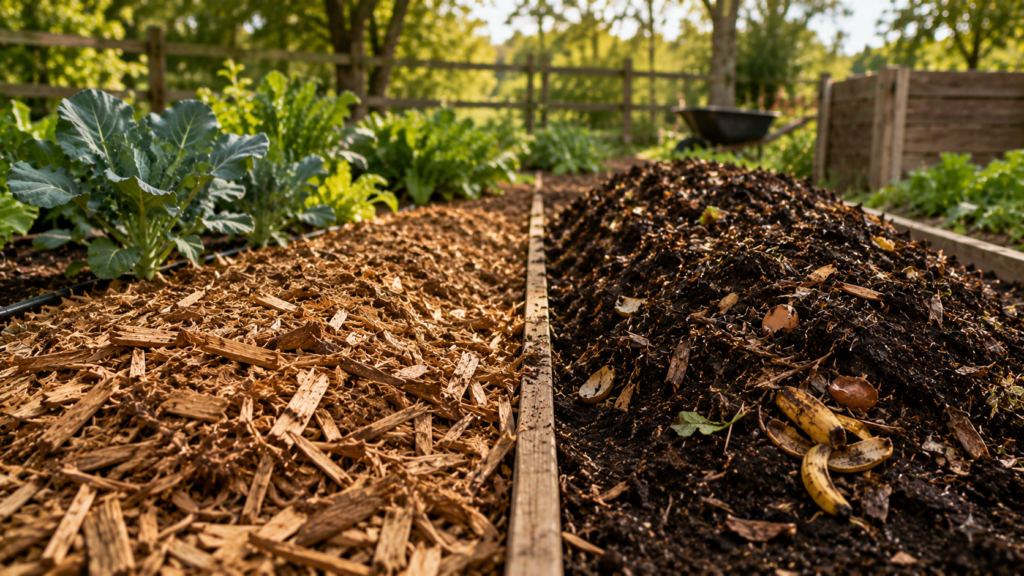
- Mulch protects the soil.
- Compost improves the soil.
The best gardens often use both together.
Once you’ve decided which material your project needs, it’s helpful to calculate exactly how much you’ll require.
→ Mulch Calculator – Imperial & Metric Units
→ Compost Calculator – Imperial & Metric Units
What Is Mulch?
Mulch is a material placed on top of the soil surface.
Its main job is protection.
Common mulch types include:
- bark mulch
- shredded hardwood
- wood chips
- straw
- pine needles
- leaves
Mulch helps:
- suppress weeds
- retain moisture
- regulate soil temperature
- reduce erosion
- improve appearance
Most mulch breaks down slowly over time.
What Is Compost?
Compost is decomposed organic material added into or onto soil.
Its main job is soil improvement.
Compost is made from:
- food scraps
- leaves
- grass clippings
- manure
- organic waste
Compost helps:
- improve soil structure
- increase nutrients
- boost microbial life
- improve drainage
- retain moisture
Healthy compost feeds the soil.
The Biggest Difference
Mulch protects soil
Compost feeds soil
That’s the simplest way to think about it.
Mulch acts like a protective blanket.
Compost acts like a soil conditioner and nutrient source.
Should Compost Be Mixed Into Soil?
Usually, yes.
Compost is often:
- mixed into raised beds
- blended into garden soil
- worked into planting areas
Typical compost amounts:
20%–40% of total soil volume
Compost can also be top dressed.
Should Mulch Be Mixed Into Soil?
Usually, no.
Most mulch is designed to stay on top of the soil surface.
Mixing wood mulch into soil can:
- temporarily reduce nitrogen
- slow plant growth
- affect soil balance
Exception:
Very fine organic mulches sometimes break down naturally into soil over time.
Best Uses for Mulch
Mulch works best for:
- flower beds
- landscaping
- around trees
- vegetable garden pathways
- moisture retention
- weed suppression
Recommended mulch depth:
2–4 inches
Best Uses for Compost
Compost works best for:
- raised beds
- vegetable gardens
- soil rebuilding
- poor soil improvement
- boosting plant growth
Typical compost application:
1–3 inches worked into soil
Can You Use Mulch and Compost Together?
Absolutely.
In fact, many gardeners get the best results by using both.
Example setup:
Step 1:
Add compost into soil to improve nutrients and structure.
Step 2:
Apply mulch on top to protect that improved soil.
This combination improves:
- moisture retention
- plant growth
- soil health
- weed control
Mulch vs Compost for Raised Beds
For raised beds:
Compost is essential
Mulch is optional but helpful
Compost builds fertile growing soil.
Mulch helps:
- reduce watering
- suppress weeds
- stabilize soil temperatures
Straw mulch is especially popular in vegetable gardens.
Which Lasts Longer?
Mulch
Usually lasts:
- several months
- up to multiple years depending on type
Compost
Breaks down faster because it actively feeds soil life.
Often replenished:
- every season
- annually
Common Gardening Mistakes
Using mulch instead of compost
Mulch does not replace healthy soil nutrients.
Using compost as thick mulch
Too much compost on the surface can:
- retain excess moisture
- create nutrient imbalances
Applying mulch too deeply
More than 4–5 inches can harm plants and roots.
Use Calculators to Estimate Materials
Manual math works—but calculators prevent overbuying.
Our calculators help estimate:
Mulch Calculator
- cubic feet
- cubic yards
- bag counts
- bulk mulch needs
Compost Calculator
- compost volume
- bag counts
- raised bed needs
- bulk compost estimates
Helpful Gardening Guides
→ Best Mulch for Vegetable Gardens (What Actually Works)
→ Best Mulch Depth for Flower Beds, Trees, and Vegetable Gardens
→ How Much Mulch Do I Need Around Trees?
→ Mulch vs Wood Chips: Which Is Better for Landscaping?
→ Bagged Mulch vs Bulk Mulch: Which Saves More Money?
→ Best Compost for Raised Garden Beds