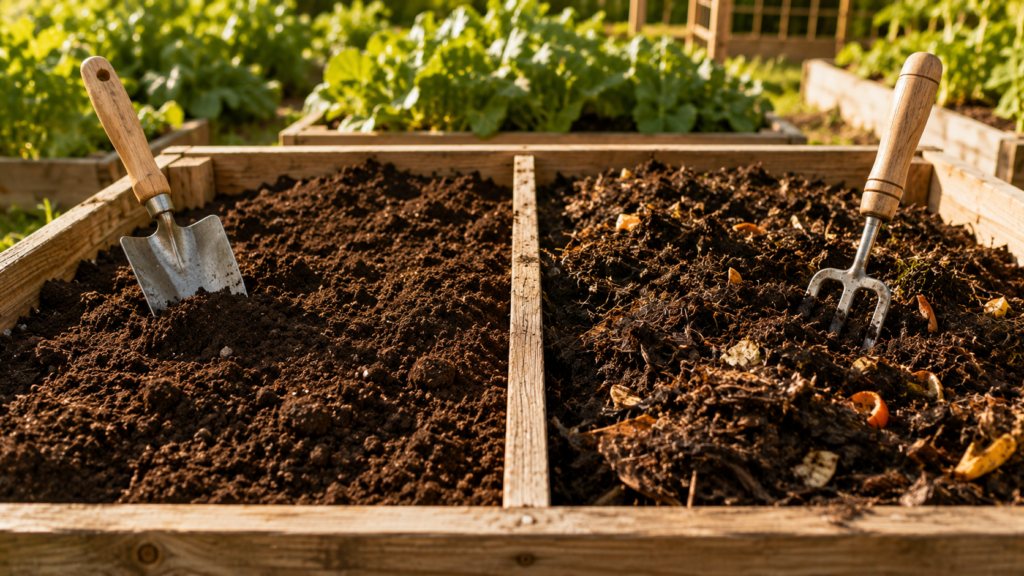
Topsoil vs compost for raised beds is one of the most common questions gardeners ask when building a new raised garden bed.
For most gardeners, the best answer is a balanced mix of both.
Topsoil provides structure, volume, and root support, while compost adds nutrients, improves soil health, and helps plants grow stronger over time.
Using only topsoil can lead to compacted soil with fewer nutrients, while using only compost may cause excessive settling and moisture problems.
The best raised beds combine both materials to create healthy drainage, strong root growth, and long-term garden success.
Once you’ve chosen the right soil blend, the next step is determining exactly how much you’ll need for your raised bed.
→ Raised Bed Soil Calculator – Imperial & Metric Units
What Topsoil Does
Topsoil creates the main foundation of your raised bed.
It provides bulk, supports root growth, and helps retain moisture while allowing proper drainage when the soil quality is good.
High-quality screened topsoil is often the most affordable way to fill the majority of a raised bed, especially for larger gardens.
However, topsoil alone can become compacted and may lack enough nutrients for strong vegetable growth.
That is why compost matters.
What Compost Does
Compost improves fertility and soil biology.
It adds nutrients, beneficial microbes, and organic matter that help plants grow healthier over time.
Compost also improves water retention and helps break up heavy soils that may compact too easily.
Good compost is one of the best long-term investments for raised bed gardening.
However, using only compost can cause excessive settling and may hold too much moisture depending on the material.
Balance is better.
The Best Soil Mix for Raised Beds
A common and highly effective raised bed mix is:
- 60% topsoil
- 30% compost
- 10% aeration material
Whether you are measuring in cubic feet or cubic meters, the same topsoil-to-compost balance stays the same.
Gardeners using metric measurements can simply scale the same topsoil and compost ratio using liters or cubic meters.
Aeration materials can include coarse sand, perlite, pine fines, vermiculite, or aged leaf mold.
This blend creates strong drainage, healthy root development, and excellent long-term soil health.
It also keeps costs lower than buying expensive bagged raised bed mixes.
Can You Use Only Compost?
You can, but it is usually not the best long-term solution.
Pure compost may settle heavily over time and can become too rich for some plants, especially seedlings.
It may also hold too much moisture depending on the compost source.
Most gardeners get better results by using compost as part of a balanced soil mix rather than the entire growing medium.
Think of compost as the nutrient engine, not the entire foundation.
Helpful Gardening Guides
→ Best Soil Mix for Raised Garden Beds
→ Cheap Ways to Fill Raised Beds
→ Raised Bed Depth Guide for Vegetables
→ Best Vegetables for Raised Beds
→ How Much Soil Do I Need for a 4×8 Raised Bed?
→ How Many Bags of Soil Do I Need for a 4×8 Raised Bed?